PixelFed Analytics Engineering
A reproducible social-content analytics project built around a relational schema, mixed-format landing files, and a galaxy semantic model.
A question. A process.
Work you can explore.
Follow the decisions behind the implementation, then inspect the original work.
Chapter 1 of 4 · The question
The question behind the build.
Social-content data has different event grains, optional values, and timing constraints. Landing data also arrives in different file formats. Cleaning everything with the same rule can quietly change its meaning.
Follow the implementation.
- 01
Generate deterministic synthetic data against a documented schema contract.
- 02
Separate natural optional nulls from deliberately injected raw-data quality issues.
- 03
Validate a candidate landing refresh before explicit promotion and retain the prior snapshot.
- 04
Use Power Query staging and conformed dimensions with grain-specific facts and documented relationships.
See the work. Inspect the details.
The project makes the raw-to-Silver workflow reviewable: schemas, null-handling policies, validation, and manual Power Query guidance sit alongside the implementation.
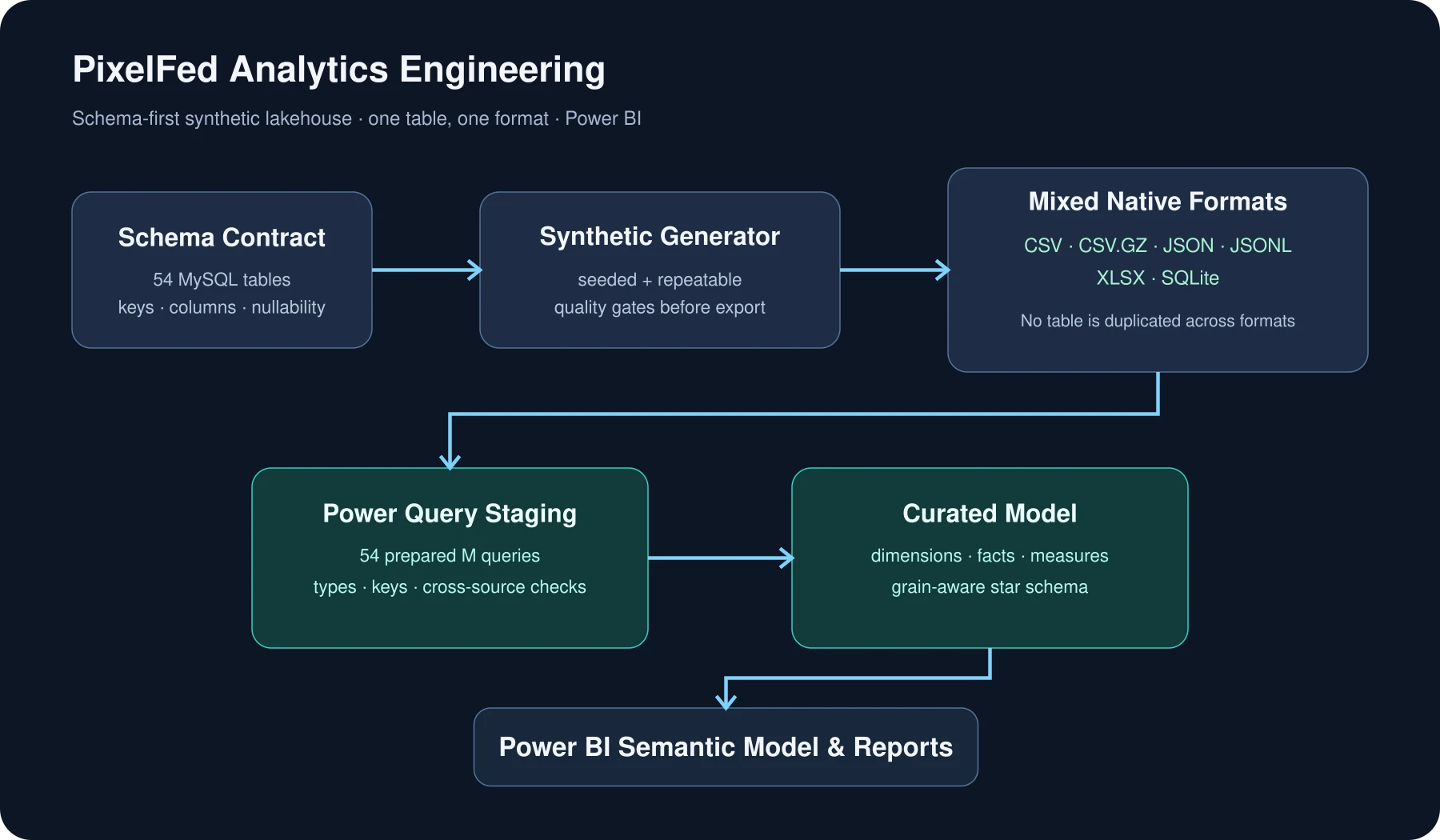 Enlarge preview
Choose where to look deeper.
Search the linked source inventory or narrow it to the kind of artifact you want to inspect. Files open at their original source.
8 linked source files
No linked files match this view.
The source
keeps moving.
Source updated
Production-Grade Analytics Engineering Lakehouse, Multi-Format Ingestion Engine, and Power BI Semantic Model
Current README excerpt
[](https://github.com/Sohila-Khaled-Abbas/pixelfed-analytics-engineering/actions) [](https://www.python.org/) [](https://powerbi.microsoft.com/) [](docs/architecture/system-architecture.md) [](schema.md) [](https://drawsql.app/templates/pixelfed) [](https://github.com/astral-sh/ruff) [](tests/) [](LICENSE)
A source excerpt, not an independently verified outcome.