Employee Directory Project
Build a structured SQL database + ERD for the Employee Directory dataset (44 columns). The goal is to normalize the flat file, reduce redundancy, and enable efficient queries for reporting, analytics, and integration with BI tools.
A question. A process.
Work you can explore.
Move from the project’s purpose to its available previews and source files.
Chapter 1 of 4 · The question
What this project explores.
Build a structured SQL database + ERD for the Employee Directory dataset (44 columns). The goal is to normalize the flat file, reduce redundancy, and enable efficient queries for reporting, analytics, and integration with BI tools.
Follow the implementation.
The repository documents Employee Directory Project. Start with the README and follow its setup and implementation files; the source collection below gives you a way into the work.
Read the implementation notesSee the work. Inspect the details.
The source files and README are the available evidence for this project. Open them to review the implementation and its assumptions.
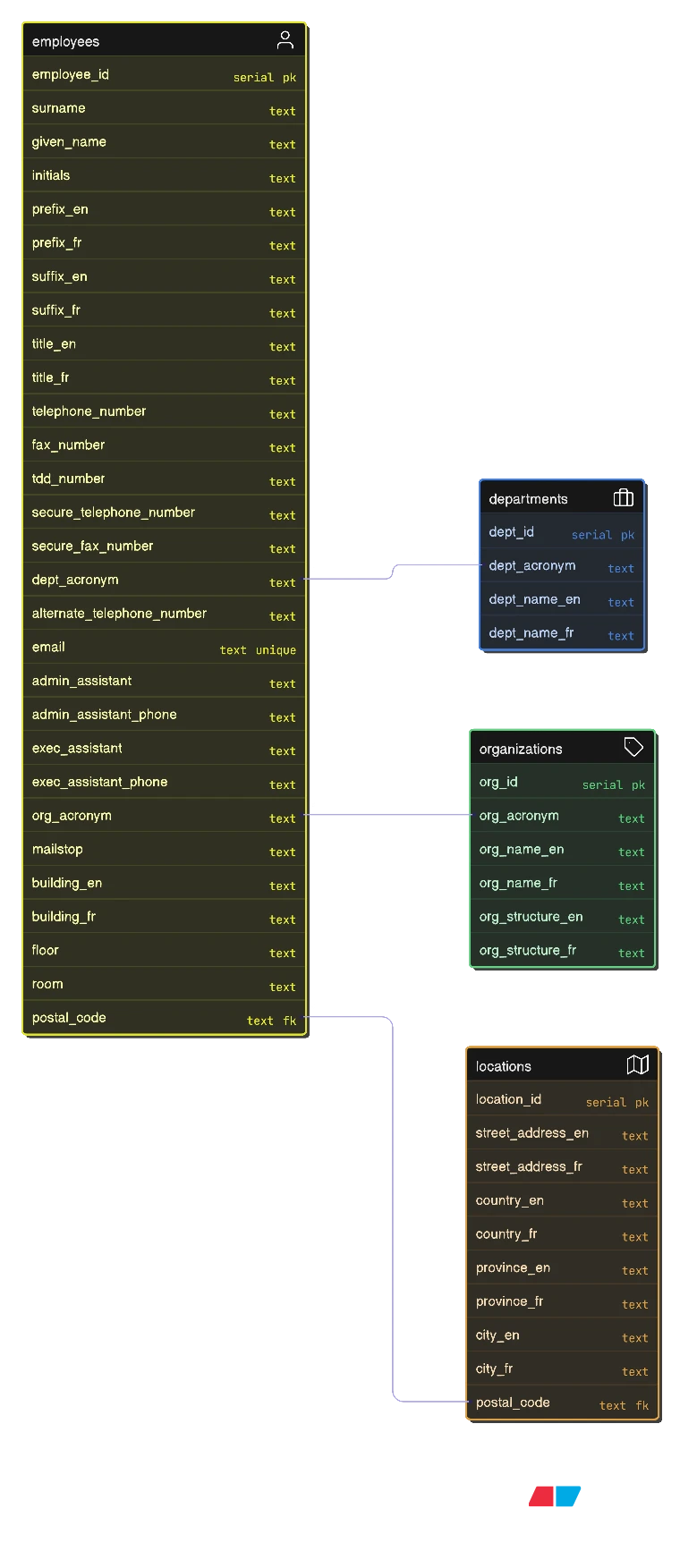 Enlarge preview
Choose where to look deeper.
Search the linked source inventory or narrow it to the kind of artifact you want to inspect. Files open at their original source.
7 linked source files
No linked files match this view.
The source
keeps moving.
Source updated
Build a structured SQL database + ERD for the Employee Directory dataset (44 columns). The goal is to normalize the flat file, reduce redundancy, and enable efficient queries for reporting, analytics, and integration with BI tools.
Current README excerpt
This project builds a searchable employee directory using PostgreSQL and Power BI, based on the Government of Canada - Federal Employee Directory dataset.
A source excerpt, not an independently verified outcome.